Measuring the effectiveness of their security of your Security Operations Center (SOC) is critical to improving its performance and maintaining a strong security posture for your organization. In this post, we’ll take a look at SOC Metrics and KPI – key performance indicators and other metrics used to measure SOC security operations program, as well as provide real-life examples so that you can gain a greater understanding of their significance and application.
What is KPI in Security Operations Center?
Key Performance Indicators (KPIs) are metrics used to evaluate the effectiveness of their security operations and assess potential areas for improvement, along with tracking progress over time.
KPIs also evaluate an organization’s security and senior management team’s policies, procedures, and processes against industry regulations ensuring they stay up to date and compliant at all times.
How to Implement and Measure SOC Metrics & Key Performance Indicators for Your Organization?
Implementing effective SOC reporting metrics and using powerful security operations center performance monitoring tools are integral to managing and optimizing the performance of any security operations center and analysts.
In this guide, we’ll cover how to set up successful soc metrics and kpis to get key metrics and maximize the efficiency of your security operations center.
Establish Relevant Metrics: Begin by selecting SOC reporting metrics that align with your organization’s goals and objectives to effectively track SOC performance and evaluate cybersecurity efforts. Doing this will allow you to effectively track their success as part of an overall cybersecurity program.
Select the Appropriate Tools: Selecting appropriate security operations center performance monitoring tools is critical to collecting, analyzing, and reporting on data regarding SOC performance. They must be user-friendly with real-time insights provided as well as being flexible enough to accommodate changing organizational needs.
Set Measurable KPIs: Establish clear and measurable key performance indicators (KPIs) to accurately gauge the success of your SOC initiatives. KPIs should address areas like incident response time, threat detection rate and false positive rates to provide comprehensive performance tracking of SOC services.
Set Up Frequent Reporting on SOC Performance: Establish a regular report cycle on Security Operations Center performance to keep stakeholders up-to-date and foster an environment of continuous improvement, which will allow you to detect any gaps or vulnerabilities promptly and address them quickly.
Key SOC Security Metrics and KPIs in Cybersecurity
Here are the SOC KPIs and Metrics to measure:
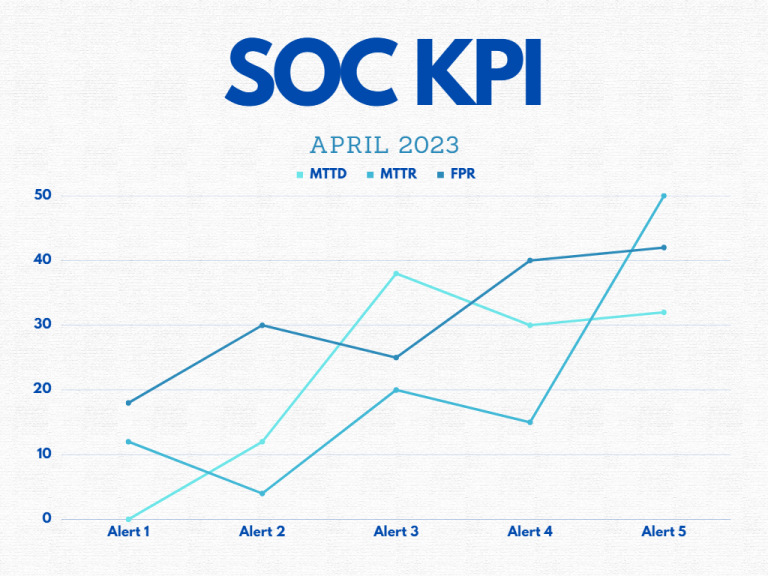
Mean Time to Detect (MTTD)
Tracking Mean Time To Detect (MTTD) allows your Security Operations Center (SOC) to assess its detection capabilities and pinpoint any opportunities for improvement based on the time taken.
A shorter MTTD alarm time indicates faster response to incidents; tracking this important metric also provides insight into SOC detection capabilities and areas for development. This helps to detect and respond quicker with actionable items.
Mean Time to Respond (MTTR)
Your Security Operation Center (SOC) security leaders should have an average mean time to response (MTTR) measure that determines their ability to effectively prioritize and allocate resources to respond to incidents. A lower MTTR indicates your team is prioritizing incidents appropriately.
Security Incidents Volume
An incident volume measures on average time the total number of security incidents identified by your SOC over a certain timeframe. Tracking incident volume helps assess overall organization security while also revealing trends or patterns among detected security threats.
False Positive Rate
A false positive rate measures the percentage of detected security alerts which, upon further examination, prove non-threats. A high false positive rate can waste resources and decrease team efficiency during cyber attacks.
Incident Escalation Rate
An incident escalation rate measures the percentage of incidents that require further resolution from higher-level team members or external experts, typically through escalated calls.
An elevated escalation rate could indicate either insufficient expertise within your SOC team, or indicate additional resources may be necessary to effectively address incidents. A high escalation rate might signal either a risk that more expertise needs to be added in, or additional personnel.
Real-World Examples of a SOC Performance with Common SOC Metrics

Mean Time to Detect (MTTD)
One company noticed their Mean Time To Deliver has increased over the past month and after investigating why, identified that its security monitoring tools weren’t optimized to respond to real threats in today’s threat landscape. They decided to update security patches and configure them in order to detect newer threats more effectively, which reduced its MTTD.
Mean Time to Respond (MTTR)
An organization observes a noticeable increase in its MTTR. After conducting further investigation, they identify that their incident response process is too complex and time-consuming to meet today’s business demands. They simplify it while offering additional training sessions to their incident response team members thereby decreasing MTTR significantly.
Incident Volume
A company notices an unexpected spike in incident volume. They analyze root cause of these incidents and discover most are related to phishing attempts; accordingly, they take additional, security awareness measures such as training users or email filtering to reduce risks from these types of attacks. This can be extracted from a SIEM tool used for detection and response.
False Positive Rate
A SOC security team discovers its false positive rate is significantly higher than the industry norm. They conduct an assessment, realizing their threat intelligence tooling was outdated, causing unnecessary alarms. They then update their system to cut down on false positives.
Incident Escalation Rate
In a medium-sized enterprise, SOC finds that a significant number of incidents are escalated to higher-level personnel. Analyzing the data, they realize their on-the-ground personnel require more training to handle complex issues, and subsequently, conduct more in-depth training sessions.
Using SOC Metrics and KPI Effectively for a Successful SOC
- Your SOC should be monitored and reviewed on an ongoing basis to assess its cyber threat landscape and performance data.
- Benchmarking allows you to measure the performance of your SOC against industry averages or similar organizations. Regular cybersecurity assessments can also help in understanding where you stand.
- Set reasonable targets for improvement and track your progress toward them. Use insights gleaned from SOC metrics to guide the planning and implementation of operational improvements in areas like threat intelligence.
- To reduce risks associated with SOC analysis: Be mindful of any gaps or limitations in your risk management and security metrics system that might exist.
- Work together with risk assessment teams and other departments within your organization in order to accurately compare your baseline performance against that of others in your organization.
- Use objective criteria when comparing yourself with others, ensuring that data privacy and protection standards are maintained.
How to Analyze and Utilize Results from Key SOC Metrics & KPIs

Effectively interpreting and using results from your SOC’s performance data sources, metrics, and KPIs is vital for optimizing your organization’s data security framework and cybersecurity posture.
- Analyze Your SOC Data: Start by carefully reviewing all of the SOC reporting metrics and KPIs generated from your organization’s cyber risk assessment tools and security operations center performance reporting metrics and KPIs. Keep an eye out for any patterns, trends, or anomalies which might give valuable insight into its security operations center performance.
- Compare SOC Performance Data With Industry Benchmarks and Best Practices: It is important to compare your SOC performance data against industry benchmarks and best practices to assess areas in which your organization may be underperforming or outshone its peers and competitors. Using threat intelligence platforms can give a better indication of where you stand compared with these groups.
- Utilize Your Analysis Results to Pinpoint Areas Needing Improvement: Leverage the insights gained through your analysis to pinpoint areas within your security operations center that require improvements, and prioritize these based on potential impact to the overall data protection and cybersecurity posture of the organization.
- Create an Action Plan: Once identified areas for improvement have been identified, create a comprehensive action plan with specific goals, timelines, and responsibilities for each initiative to address them, ensuring they align with GDPR compliance and other regulations.
- Monitor Progress: To stay apprised of your action plan’s progress, regularly track SOC metrics and KPIs as part of an action plan’s evaluation and implementation processes. This will allow you to assess their effectiveness as initiatives roll out and adjust any necessary strategies when necessary, while ensuring ISO 27001 compliance. Also Check Out CISA’s Zero Trust Security Model.
- Communicate Results: Make your SOC data, insights, and progress known to all relevant stakeholders including executive leadership, IT teams, and other departments within your organization, ensuring data breach notifications are communicated promptly.
- Iterate and Refine: Draw upon feedback and results from your action plan to hone and refine SOC metrics and KPIs, helping your security operations center to continually adapt to an ever-evolving cybersecurity environment. Reevaluate regularly to make sure they remain pertinent and align with organizational goals and regulatory compliance.
Assessing the Pulse of Your SOC Team's Performance in Incident Response
Navigating the intricate world of cybersecurity, one quickly realizes the paramount importance of regularly gauging and articulating the performance of a SOC team. Let’s unpack the myriad advantages of such diligent assessments while also ensuring data security compliance:
- Elevating Cyber Defense Mechanisms: When you meticulously assess your cybersecurity protocols and security controls, especially by leveraging advanced threat intelligence, you’re essentially shining a light on potential soft spots. Addressing these proactively not only wards off potential threats but also ensures a robust defense for the organization’s digital realm. It’s akin to fortifying a castle; every weak stone replaced strengthens the entire structure.
- Sharpening Organizational Choices: Armed with accurate and current data on the SOC’s operations, decision-makers can craft strategies with precision. By utilizing the network anomaly detection tools and the insights they provide, reallocating resources or modifying the security framework becomes more streamlined. Clarity, thus, paves the way for nimble adjustments in the face of emerging threats.
- Cultivating Collective Accountability: Routine evaluations, paired with transparent communication, sow seeds of responsibility across the board. It’s a collective call to arms, reminding every individual of their crucial role in sculpting a secure digital landscape and their responsibilities in terms of incident response.
- Showcasing Adherence Through Consistent Reviews: Regular check-ins, bolstered by comprehensive audit trails, serve a dual purpose: they keep the team aligned and act as tangible proof of compliance with industry standards, such as GDPR and ISO 27001. This not only sidesteps potential legal pitfalls but also cements trust with external stakeholders.
- Championing an Ethos of Relentless Refinement: By championing a culture that’s rooted in ceaseless betterment, and by utilizing the feedback from user behavior analytics, an organization ensures it remains resilient. Regular introspection and recalibration of SOC operations mean you’re perpetually poised to tackle the shifting sands of cybersecurity challenges.
To Conclude: Navigating the SOC Metrics & KPI Labyrinth
In our interconnected era, cybersecurity stands as a beacon of paramount importance. With the help of continuous monitoring techniques, understanding the nuances of SOC metrics and KPIs is more than just a technical exercise—it’s a shield, safeguarding your organization from the lurking shadows of cyber adversaries. This discourse aims to illuminate these metrics, interspersed with tangible examples, emphasizing their indispensable role in crafting a digital bulwark.