Demystifying the CISA Zero Trust Maturity Model for Enhanced Cybersecurity
In a recent development, the Cybersecurity and Infrastructure Security Agency (CISA) unfurled and provided its CISA Zero Trust Maturity Model. The objective? To arm organizations or enterprises with a robust toolset for amplifying their cybersecurity infrastructure. Let’s dive deep into its nuances, the pathway it lays out, and its potential implications for your organization.
Zero Trust Architecture (ZTA): A Glimpse of the Resource
Gone are the days when traditional security models took users and devices at face value. ZTA shifts the paradigm and makes it advanced – trust no one, always verify. Rooted deeply in the principle of ‘least privilege’, ZTA is about giving access only when it’s unequivocally required.
The CISA’s Zero Trust Maturity Model, or ZTMM, serves as a beacon, illuminating the path for organizations to embed Zero Trust protocols seamlessly.
This model not only assists organizations in evaluating their cybersecurity stance but also pinpoints improvement zones. Moreover, it serves as a guide to effectively roll out Zero Trust Architectures, encompassing key areas like authorization, threat detection, application security, and much more.
Zero Trust Security: A Revolution in the Making
The rapid ascension of Zero Trust Security isn’t by chance. It’s a transformative approach to Zero Trust that’s redefining the contours of organizational cybersecurity.
CISA’s Maturity Model provides and meticulously charts the journey towards zero trust, peppering it with clear milestones. Its spotlight doesn’t just hover over one area but spans across identity management, device protection, and data access controls.
The gravitas of adopting CISA’s zero trust model cannot be understated. It secures organizations, shielding their digital real estate, user identities, and infrastructure, especially in the face of evolving cyber threats. It’s an optimal and holistic approach, ensuring adaptability amidst the ever-shifting dynamics of an organization’s environment, security posture, cyber threats, and digital metamorphosis.
Decoding the CISA Zero Trust Maturity Model to Implement in Your Organization
ZTMM’s Proposition: This model promotes a sophisticated zero trust architecture. At its core lies a relentless emphasis on authentication and authorization. The endgame? To ensure that only the verified elite gain access to critical data.
Let’s break it down:
- Device Protection: Bolster the defenses of end user devices.
- Authentication and Visibility: Centralize authentication protocols while ramping up visibility controls.
- Data Access: Employ rigorous controls over data access to curb the attack surface.
The roadmap drawn by ZTMM is lucid. It aids organizations in discerning the chinks in their cybersecurity armor, nudging them towards a more mature zero trust stance. Embracing this journey not only amplifies protection of digital assets but also fosters a deep-rooted awareness of looming cyber threats.
A Deep Dive into the Essential Five Pillars of ZTMM
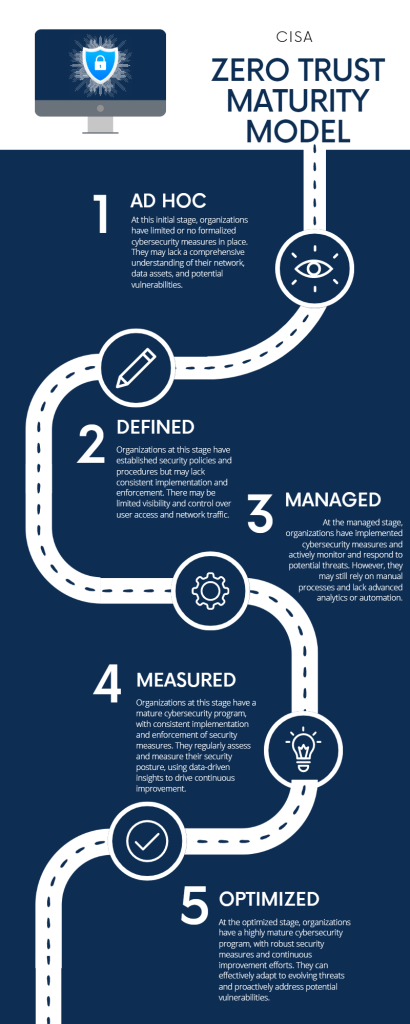
1. Ad Hoc
Many budding organizations find themselves here, often oblivious to their own vulnerabilities.
- Counter-Strategy: Map out all network devices, cloud spaces, and potential threat vectors. Draft a security policy rooted in clear objectives.
2. Defined
Here, organizations have policies etched out, but consistency in enforcement remains a challenge.
- Counter-Strategy: Leverage role-based access control and heighten user authentication. Tool up with firewalls, IDS, and SIEM solutions for an eagle-eye view on threats and endpoints.
3. Managed
Firms here have moved past basic security measures. Yet, the allure of manual, cost-effective processes and workload persists.
- Counter-Strategy: Infuse analytics and automation, accelerating threat detection and minimizing human-driven errors.
4. Measured
Organizations now have a well-structured cybersecurity framework and are data-driven.
- Counter-Strategy: Set measurable KPIs. Periodically audit, tweak, and innovate security protocols.
5. Optimized
At the pinnacle, organizations are always on the lookout for potential cyber pitfalls, ensuring top-tier preparedness.
- Counter-Strategy: Stay updated. Embrace threat intelligence and industry benchmarks for staying ahead.
A Blueprint of ZTMM and its Applications
To truly harness the ZTMM’s potential, organizations must follow CISA’s ZTMM guidance:
- Assess their cybersecurity maturity with precision under governance.
- Envision the trajectory to ascend to higher maturity levels.
- Allocate ample resources, be it funds, talent, or tech.
- Stay nimble, pivoting their cybersecurity strategy as needed.
Best Practices: Beginning with CISA’s guidelines is prudent. Align security objectives with organizational goals. Regularly conduct risk assessments, and continuously fortify your cybersecurity defenses to seamlessly progress on the ZTMM journey.
In Conclusion
Embracing the CISA Zero Trust Maturity Model is akin to embarking on a transformative journey. It’s about bolstering cybersecurity defenses, preemptively mitigating risks, and ensuring that systems and networks remain impervious to threats.