
Deciphering the Interplay of the OSI Model Layers: A Comprehensive Examination
In the 1980s, the creation of The OSI Model marked a breakthrough in understanding data communication among computers. Each layer, from start to finish in the OSI model, plays a specific role in the process, essential for effectively troubleshooting arising issues.
Formulated by the International Organization for Standardization (ISO) in 1984, the OSI Model is an abstract construct used to demystify how computers exchange data. The model, featuring seven layers, assigns distinct responsibilities to each layer. Layers 1-3 handle rudimentary aspects at the bottom, while the upper layers 5-7 tackle higher-level tasks on top. This model becomes handy in diagnosing issues that occur during data transmission, whether it be over networks or other methods, such as Bluetooth or USB connections.
Here’s a breakdown of the seven distinct layers encapsulated in the OSI model’s end-to-end layer:
- The Physical Layer: This undermost layer illustrates how data migrates from one location to another through copper cable, airwaves, or fiber optic cables.
- The Data Link Layer: Responsible for packet formation and addressing, it determines data flow between two endpoints or establishes and terminates virtual circuits, relying on the involved protocols like Ethernet. Mainly uses Physical Address for communication.
- The Network Layer: Manages the route of data packets by packet forwarding, ensuring loop-free delivery to their destination. Packets are decomposed into smaller fragments known as datagrams for parallel delivery over multiple routes. Mainly uses IP Address for communication.
- The Transport Layer: Manages the reliability, flow control, and delivery of datagrams across a network along with error correction.
- The Session Layer: Forms and maintains sessions between a server and client using transport protocols such as UDP or TCP.
- The Presentation Layer: Formats information according to the application layer‘s specific requirements.
- The Application Layer: Caters to application specifics, such as HTTP requests and responses, or peer message exchange.
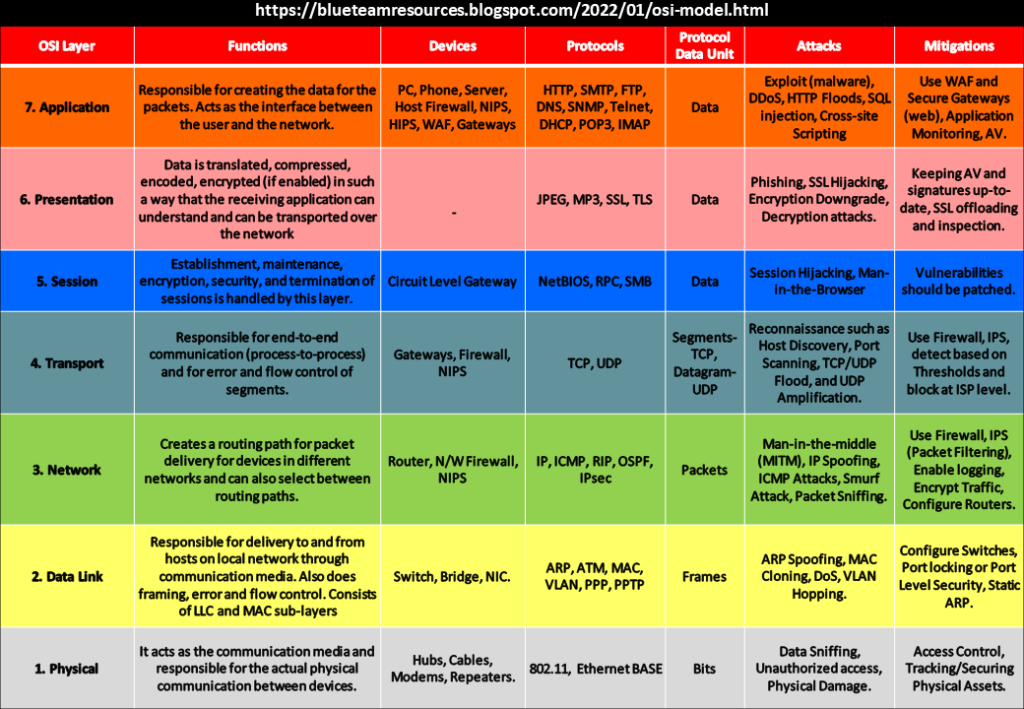
Unravelling the OSI Model’s End to End Layer
In the context of network design, the OSI model serves as a practical guide to understanding the layers involved in a network. This model is a protocol stack, partitioning data organization and transmission over a computer network, with each layer addressing a unique facet of networking, often with its own sub-layers.
Each layer within the OSI model’s end-to-end layer is further defined below:







Layer 7 - Application Layer:
This topmost layer of the OSI model houses software application protocols and services associated with them. It mediates the communication between distinct applications or software programs, identifying, addressing, and applying compression and encryption to data packets. This layer operates as an abstraction of the lower layers, relying on them for direct services to end users.
Application Layer Protocols: HTTP, SMTP, FTP, DNS, SNMP, Telnet, DHCP, POP3, IMAP.
Layer 6 - Presentation Layer:
The sixth layer of the OSI model, it converts messages from the application layer into a network-understandable format. Herein, encryption and data compression occur, along with the decryption of data encrypted by the application layer.
Presentation Layer Protocols: JPEG, MP3, SSL, TLS.
Layer 5 - Session Layer:
This fifth layer of the OSI model provides services that allow applications to function without a specific network connection. It establishes, maintains, and terminates connections between two endpoints, managing the data exchange between applications.
Session Layer Protocols: NetBIOS, RPC, SMB.
Layer 4 - Transport Layer:
As the fourth layer of the OSI model, it oversees data packets’ handling sent across a network. This layer manages receiving and assembling packets from the internet layer, sending these packets to the network layer, and breaking up large messages into smaller ones for transmission. Also does error checking.
Transport Layer Protocols: TCP (Transmission control protocol), UDP (User datagram protocol).
Layer 3 - Network Layer:
This networking layer engineers a delivery route for data packets from source to destination for devices in varying networks, even selecting among various routing paths using IP Address.
Network Layer Protocols: IP (Internet Protocol), ICMP, RIP, OSPF, IPsec.
Layer 2 - Data Link Layer:
This layer establishes a logical link between the source and destination node, ensuring error-free packet delivery. It can be subdivided into two sub-layers: Media Access Control Layer (MAC) and Logical Link Control (LLC). The former controls shared media access by using the Physical address, and the latter oversees frame synchronization, flow control, error control, among other functions.
Link Layer Protocols: ARP, ATM, MAC, VLAN, PPP, PPTP.
Layer 1 - Physical Layer:
The lowest layer forms the communication medium, facilitating physical communication between devices with transmission modes such as wired or wireless network also know as communication channels. This requires physical connections between the devices.
Physical Layer Protocols: 802.11, Ethernet BASE.
Significance of the OSI Model in Cybersecurity
The OSI model, a system for comprehending the communication process between two devices, plays a significant role in cybersecurity. As the usage of the end-to-end OSI model, established in the 1980s, became widespread, its role in cybersecurity has only amplified. This model helps dissect different layers of the network and pinpoint vulnerabilities that could be potential hacker targets.
Understanding the OSI Model: Why it matters
The Open Systems Interconnection (OSI) model, a type of conceptual models, characterizes and standardizes a telecommunication or computing system’s communication functions. As the threat of hacking looms with the increasing interconnectivity of systems, the end-to-end layer in the OSI model can enlighten us about how different layers interact and where they might be vulnerable.
Comparison with TCP/IP Model
Diving into the world of network communication, we come across two behemoths – the OSI model and the TCP/IP model. At first glance, they may seem identical twins, but when you peel back the layers, you’ll find two different beings, each with its unique approach to network communication.
The OSI model, the standard model and a veritable skyscraper with its seven-layered approach, is like a multilingual interpreter with common protocols as well as uncommon protocols. It allows diverse protocols to converse fluently with each other, smoothing the way for seamless network interaction.
Picture a bustling international airport, filled with travellers speaking a plethora of languages. The OSI model is the tireless translator, enabling communication and ensuring that everyone reaches their destination without a hitch.
Now, let’s turn our gaze to the TCP/IP model. Not as towering as the OSI model with different protocol stacks, but equally potent. It’s an integrated protocol suite with standard protocols and common protocols, outlining the blueprint for data transmission over a network. Imagine a postal service – TCP/IP is the set of rules that ensures your parcel is picked up, transported, and delivered correctly to the recipient’s doorstep, regardless of the distance or the weather.
Despite their differences, both models share a common goal. They serve as the foundation for end-to-end communication, providing a secure platform for devices to connect and interact. Think of them as the unsung heroes behind your smooth video calls, fast downloads, and secure online transactions. They work tirelessly behind the scenes, ensuring your digital world stays interconnected and secure.
A Closer Look at the End-to-End Layer in the OSI Model
The end-to-end layer in the OSI model, a layered model, categorizes network communication functions into seven different layers starting from the upper layers: Application, Presentation, Session, Transport, Network, Data Link, and Physical.
The Application Layer, the uppermost layer in the OSI model, offers services to users and applications running on end-user systems. The Presentation Layer manages data formatting and encryption for network transmission, converting it into data packets decipherable at the receiving end. The Session Layer controls how two communicating systems establish and maintain error-free sessions.
The Transport Layer ensures error-free delivery of packets to their destinations. The Network Layer uses routers and switches to route packets from one node to another in an inter-network or LAN, ensuring swift and accurate delivery. The Data Link Layer forms reliable links between network nodes using various technologies such as Ethernet.


