
Introduction to SOC Alert Analysis
In the labyrinthine world of cybersecurity, Security Operations Centers (SOC) often serve as the vigilant guardians, constantly on the lookout for any malicious activity. Investigating a SOC alert is akin to embarking on a critical mission.
The intention? To uncover the often enigmatic patterns of suspicious activities and the potential security threats lurking beneath them, thereby strengthening the organization’s cybersecurity posture.
But what’s the process? How does a security team maneuver through the seemingly endless stack of security tools, transforming potential threats into actionable intelligence?
Overview of the Questions
- How does the attack that triggered the alert work? (The Science of The Attack)
- What data should I be looking for? (The Quest for The Right Data)
- Where and How can I get the Data? (The Source: Where and How to Get The Data)
- Does the data indicate an attack? (From Data to Detection: Does the Data Indicate an Attack?)
- What to do next? (The Road Ahead: What to Do Next?)
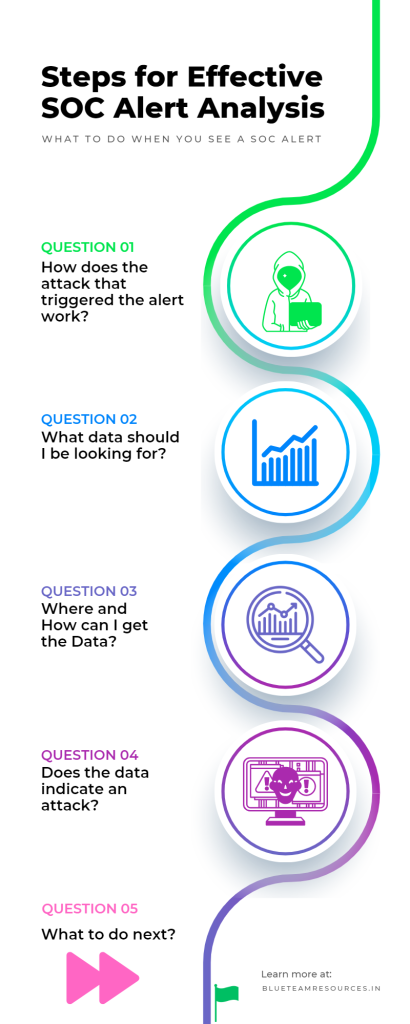
A Comprehensive Guide to Investigating a SOC Alert
The Science of The Attack
How exactly does the attack that initiated the security alert function? Demystifying this cyber puzzle is the cornerstone in devising a resilient response strategy. Whether it’s malware analysis or a deep dive into network activity, security analysts must unravel the attack’s intricacies.
Understanding its characteristics and patterns, peering beyond false positives, and recognizing the sheer volume of alerts are the initial steps in enhancing security controls.
The Quest for The Right Data
The second quandary is identifying the correct data to look for. The cybersecurity industry demands examining a wide range of data – from log management to user inputs – to delineate the scope of an intrusion detection system alert.
It’s not merely a matter of sifting through logs or network monitoring; skilled analysts must explore system configurations, behavioral analysis, IP reputation, and even user activity trends. Detecting an anomaly or abnormal network behaviors in the vast seas of data becomes a craft, necessitating a refined understanding of security systems.
The Source: Where and How to Get The Data

Acquiring the data is a complex ballet. Security professionals must adeptly navigate through the cybersecurity solution landscape, leveraging third-party services, cybersecurity leader tools like Trend Micro, or even active directory users and computers.
Whether deploying forensic software or utilizing ArcSight Intelligence, the access to resources must be accurate and timely, typically within a matter of 30-60 minutes.
From Data to Detection: Does the Data Indicate an Attack?
Transforming data into quality detections requires a critical eye. The security operations staffing must correlate various information sources to identify indicators of compromise. Comparing the data to known attack signatures, employing advanced analytics, or even leveraging machine learning with Next-Gen SIEMs can unveil the nature of the event. With accurate detection, the threat landscape suddenly becomes clearer, moving from mere alert fatigue to substantial threat intelligence feeds.
The Road Ahead: What to Do Next?

Understanding the actual threat behavior translates to effective action. The security operations model might necessitate releasing patches or aligning with regulatory requirements. Collaborating with team members, consistent with security policies, documenting incidents, or preparing for additional attacks becomes the well-charted course of action. Security engineers must foster an adaptive security architecture, utilizing advanced security software and action report strategies.
Analyzing Security Incidents: A Deeper Dive
Level of Labeling: Making Sense of False Alarms
In the vast ocean of security incidents, distinguishing between false alarms and actual threats is an art in itself. Security analysts must meticulously label and categorize each alert to prevent unnecessary panic and maintain focus on actual threat behavior.
The introduction of advanced security analysis tools and the adoption of cloud services have considerably enhanced accurate detection abilities. Whether it’s a false positive or an endpoint detection, this delicate process demands precision within a 30-60 minute time frame.
Asset Inventory and Asset Management: The Foundation of Security
Managing an asset inventory is a crucial yet often overlooked element of a comprehensive security strategy. Advanced threat analysis necessitates a clear understanding of asset management.
From network activity to Active Directory Domain Services, the inventory holds the key to understanding abnormal trends and bad actors’ potential paths. Adopting quality detections through advanced detection tools can streamline this process, resulting in better security posture management.
Understanding Threat Intelligence: Action Items and Actionable Intelligence
Security Information and Event Management (SIEMs) like ArcSight Intelligence rely heavily on threat intelligence feeds. The ability to convert raw data into actionable intelligence is what separates mediocre security operations from industry leaders.
Understanding the threat intelligence platforms, reputation lookup services, and source intelligence is crucial in shaping the cybersecurity industry. Advanced security analysts employ next-generation SIEMs that leverage machine learning, creating a robust cybersecurity solution.
Protecting User Accounts: Privileged Accounts and User Security

The safeguarding of privileged user accounts and active directory users and computers is paramount in a world where malicious behavior is ever-evolving. The absence of security patches or a lack of skilled analysts could result in dire consequences. Strategies like behavioral analytics, the use of privileged accounts, and understanding abnormal network behaviors must be a priority.
Cybersecurity Innovations: Embracing the Future
The future of cybersecurity hinges on advanced security software and innovative strategies such as adaptive security architecture. The constant evolution of cyber threats demands a proactive approach.
Generation SIEMs leverage machine learning, and the implementation of wireless intrusion prevention systems offers an agile response to active compromises. Being a cybersecurity leader today involves a synergy of advanced analytics, cybersecurity posture enhancement, and adopting cutting-edge technologies like Trend Micro.
Conclusion: A Multifaceted Approach
Security professionals must balance a wide range of responsibilities. From managing the sheer volume and volume of alerts to dealing with advanced threats and cyber threats, the role demands a combination of skill, diligence, and innovation.
The integration of security solutions like advanced analytics, behavioral analysis, IP reputation, and network monitoring must be finely tuned. Moreover, a sound security monitoring system that leverages accurate detection, active directory, and malicious actors’ understanding is pivotal.
From the initial investigation to final resolution, handling a SOC alert is a journey that requires a vast skill set. Whether dealing with malware family specifics, monitoring a wide range of potential threats, or maintaining the absence of security agents, every detail matters. The presence of an experienced security engineer, along with a well-equipped security operations staffing, can make all the difference.
The cybersecurity landscape is complex, ever-changing, and filled with challenges. By adopting a multifaceted approach that combines technology, innovation, strategy, and a keen understanding of the threat landscape, organizations can stay ahead of potential threats and ensure robust security controls. The ability to adapt, innovate, and respond with precision is what defines success in this critical domain.
Final Thoughts
Navigating the maze of SOC alert investigation is no simple task. Yet, with a comprehensive approach that integrates false alarms, endpoint detection, anomalous activity, service delivery model strategies, user accounts management, threat actors’ recognition, cyber attacks’ experience levels, intrusion prevention systems, and more, an organization can turn potential threats into well-orchestrated defense.
With a nuanced understanding of malicious actors and actual threats, combined with advanced threat intelligence platforms and asset management, SOC teams can transform a potential catastrophe into a triumph in a matter of minutes.
Through the orchestrated cooperation of security operations teams, a proactive cyber security strategy, absence of security agents, active compromises, privileged user accounts, malicious behavior, access resources, and leveraging SIEMs and wireless intrusion prevention systems, organizations can stand resilient in the ever-evolving cybersecurity arena, ensuring that their critical systems remain shielded and robust.
Investigating security threats is no longer an auxiliary task but the beating heart of modern digital fortifications. An intricate dance of detection and response, powered by relentless innovation, holds the key to safeguarding the ever-expanding cyber frontier.


