Introduction
In today’s interconnected world, cybersecurity has become a critical consideration for every business, regardless of its size or industry. With cyber threats growing more sophisticated each day, organizations are constantly seeking robust security measures to safeguard their networks, data, and digital assets. Some companies choose to maintain in-house cybersecurity teams, while others opt for third-party solutions to streamline and enhance their protection strategies.
However, the decision to outsource cybersecurity services can be daunting, given the variety of available models. To help demystify these choices, this post delves into three of the most popular cybersecurity outsourcing models—Managed Detection and Response (MDR), Managed Security Service Providers (MSSP), and Security Operations Centers (SOC). Each model offers distinct advantages and limitations, depending on the unique needs of a business.
In this detailed comparison, we will explore the core differences between MDR, MSSP, and SOC, and how each model addresses various aspects of cybersecurity. Additionally, we’ll highlight some of the leading MDR service providers currently on the market, helping you make an informed decision when choosing the right security solution for your organization.

MDR vs MSSP vs SOC: What’s the difference?
Understanding the distinctions between MDR, MSSP, and SOC is crucial when selecting the most appropriate cybersecurity outsourcing model for your business. Each service operates differently, offering unique strengths tailored to specific security needs.
MDR (Managed Detection and Response)

Managed Detection and Response (MDR) services prioritize proactive threat detection, fast response, and advanced remediation tactics. These services are designed for businesses that need comprehensive protection from emerging cyber threats without the overhead of maintaining an in-house security team. MDR providers leverage state-of-the-art technologies, including Artificial Intelligence (AI) and Machine Learning (ML), to continuously monitor and analyze potential risks, allowing them to respond to cyber incidents in real time.
What sets MDR apart is its emphasis on predictive threat intelligence. By utilizing advanced AI/ML algorithms, MDR services can predict and identify threats before they have a chance to cause significant damage. This is paired with 24/7 monitoring and incident response services, ensuring that businesses remain secure at all times. Moreover, MDR services typically offer forensic analysis to better understand past attacks, further improving defense mechanisms against future threats.
For organizations that may not have the internal resources to manage a full-time security team, MDR provides an effective solution, bridging the gap between security monitoring and rapid response. Though MDR services may come at a higher cost compared to other models, their capability to detect, analyze, and respond to threats in real-time makes them invaluable for businesses seeking advanced cybersecurity protection.
MSSP (Managed Security Service Provider)

A Managed Security Service Provider (MSSP) offers a broader array of outsourced security services, including threat detection, prevention, and mitigation. While MSSP services encompass many of the same functions as MDR, they tend to focus on a more comprehensive suite of security operations rather than just threat response. MSSPs are typically responsible for tasks such as firewall management, intrusion detection, vulnerability scanning, and even compliance reporting, which helps businesses meet regulatory standards without a significant in-house effort.
MSSPs are an ideal choice for businesses that have an in-house IT team but need additional support to manage the complexity of their security infrastructure. They are generally more cost-effective than MDR solutions, offering a wider range of services at lower monthly subscription rates. For example, while an MDR service might focus heavily on incident response and real-time threat detection, an MSSP provides broader oversight, from security audits to patch management, making it a more all-encompassing option for organizations seeking complete cybersecurity management.
However, MSSPs typically take a more reactive approach compared to MDR services. While they are equipped to handle a variety of security issues, their broader scope can sometimes result in slower response times during critical cyber incidents, especially when dealing with more sophisticated threats. Despite this, MSSPs remain a cost-effective option for companies needing versatile security solutions.

A Security Operations Center (SOC) is a centralized team of security experts dedicated to monitoring and analyzing a company’s security posture 24/7. Unlike MDR and MSSP, a SOC can either be maintained in-house or outsourced, depending on the needs and resources of the organization. SOC teams use an array of technologies, such as Security Information and Event Management (SIEM) systems, to continuously assess potential security incidents in real-time.
The main advantage of a SOC is the full control it offers businesses over their cybersecurity infrastructure. A well-equipped SOC can manage everything from endpoint detection and response to in-depth security event analysis. For organizations that prefer to keep tight control over their security operations, building and maintaining an in-house SOC provides unparalleled customization and adaptability. On the other hand, outsourced SOC services are available for businesses that seek the expertise of seasoned cybersecurity analysts without the cost and effort of staffing an entire team internally.
That said, running a SOC requires significant investment—not only in hiring qualified personnel but also in maintaining up-to-date technologies to effectively defend against the latest threats. Outsourcing SOC services can help mitigate these costs, providing continuous monitoring and threat detection services at a more manageable price.
MDR vs MSSP vs SOC: Which is the best?
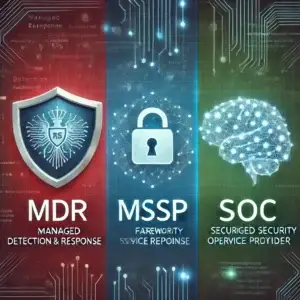
When comparing MDR (Managed Detection and Response), MSSP (Managed Security Service Provider), and SOC (Security Operations Center), the decision on which is the best largely depends on your business’s specific needs, resources, and risk management strategy. Let’s examine how each option stacks up based on critical cybersecurity needs.
MDR (Managed Detection and Response)
MDR is ideal for organizations that require proactive threat detection and real-time response to emerging cybersecurity threats. MDR providers often utilize AI and machine learning (ML) to constantly monitor, detect, and respond to threats as they arise, minimizing the time between detection and resolution. Additionally, 24/7 monitoring, incident response services, and forensic analysis are standard features of most MDR services.
For businesses that lack the internal resources to manage their own security infrastructure or those needing advanced protection without in-house expertise, MDR services are invaluable. However, they are generally more expensive than other models due to their cutting-edge technology and dedicated incident response teams.
MDR is best for organizations that face high levels of cyber threats and require continuous monitoring with rapid, automated responses.
MSSP (Managed Security Service Provider)
An MSSP provides a comprehensive range of security services, such as threat detection, prevention, monitoring, vulnerability management, and compliance reporting. MSSPs are often more cost-effective compared to MDR services, especially for companies that already have an in-house IT team and only need additional support to oversee their security infrastructure.
While MSSPs do offer a wide array of services, their focus is broader, and as a result, they may not respond as quickly to sophisticated or targeted attacks as MDR services. MSSPs are generally more reactive than proactive, which can lead to longer response times for certain security incidents.
For businesses that require general security oversight and infrastructure management but aren’t facing high-risk threats or don’t need real-time response capabilities, MSSP can be an affordable and effective solution.
SOC (Security Operations Center)
A SOC can either be maintained in-house or outsourced, offering 24/7 monitoring and real-time detection and response to threats. SOCs provide businesses with complete control over their security infrastructure, making them an ideal option for organizations that have the resources to manage their own cybersecurity operations.
SOC services typically use SIEM (Security Information and Event Management) tools to monitor network activity and detect potential threats. While SOCs are highly effective at detecting security events and responding to them in real time, they require significant investment in both personnel and technology to remain fully operational.
An outsourced SOC can be a viable option for companies that want access to expert analysts without the overhead of maintaining an internal team. However, outsourced SOCs might not provide the same level of customized threat detection as an in-house SOC.
Use cases for MDR, MSSP, SOC
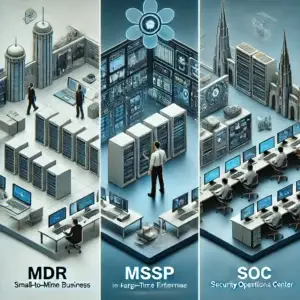
To illustrate the best use cases for MDR, MSSP, and SOC, let’s examine hypothetical scenarios based on different organizational needs.
Scenario 1: The Small-to-Mid-Sized Business (MDR)
Imagine you’re running a mid-sized business that handles sensitive customer data. Given the increasing frequency of cyber attacks targeting such information, you need a security solution capable of detecting and responding to threats in real time. However, your business lacks the resources to build a dedicated in-house cybersecurity team.
In this case, MDR services are the ideal solution. MDR offers real-time threat detection and response through advanced AI/ML-driven technology, allowing your business to remain protected around the clock. You’ll benefit from 24/7 monitoring and the expertise of security professionals without the need for significant internal resources.
Scenario 2: The Large Enterprise with In-House IT (MSSP)
Now, consider a large organization with an established in-house IT team that already manages basic cybersecurity tasks such as firewall management and intrusion detection. However, the IT team could use additional support to handle advanced vulnerability management and compliance reporting.
In this scenario, an MSSP is a fitting choice. The MSSP can provide outsourced security services to augment your existing IT team, offering solutions like vulnerability scanning and threat monitoring without needing to maintain a full-time security team. This approach allows the IT team to focus on strategic initiatives while the MSSP handles the day-to-day security operations.
Scenario 3: The Enterprise with Complex Security Needs (SOC)
For an enterprise dealing with highly sensitive data and complex infrastructure—such as those in industries like healthcare, finance, or government—an SOC provides full control over security operations. Whether it’s in-house or outsourced, an SOC can deliver comprehensive, real-time monitoring, threat analysis, and incident response.
By having a dedicated SOC, your organization can monitor and respond to incidents as they occur, preventing significant breaches before they escalate. Additionally, SOC teams can be customized to meet the specific security requirements of your organization, making them a solid choice for businesses that prioritize total control and oversight of their cybersecurity efforts.
Which Security Solution Should I Select?
Selecting the ideal security solution depends on both your business needs and budget. If your IT team requires assistance with managing security infrastructure, MSSP services may be an ideal solution.
If you need an extra layer of endpoint security but lack the resources to manage it yourself, MDR services could be an ideal way to add another level of protection. Similarly, SOC services could offer comprehensive solutions against cyber attacks.
Limitations of MDR, MSSP, and SOC
While Managed Detection and Response (MDR), Managed Security Service Providers (MSSP), and Security Operations Centers (SOC) provide essential cybersecurity support, they are not without their shortcomings. Each model has inherent limitations, which businesses must carefully weigh when selecting the right approach for their cybersecurity needs.
Limitations of MDR
One of the most significant benefits of MDR is its real-time threat detection and response capabilities, but these services come with limitations that organizations should be aware of. While MDR providers typically employ advanced AI and machine learning algorithms to detect threats, these systems are not foolproof. New and highly sophisticated threats may evade detection, especially if they exploit previously unknown vulnerabilities, sometimes referred to as zero-day attacks. In such cases, the AI-based detection systems might not identify the threat quickly enough, which could lead to delayed responses.
Moreover, MDR services are often more expensive than MSSP solutions, particularly for small and mid-sized businesses. The cost of 24/7 monitoring, incident response, and forensic analysis can be prohibitive for companies with limited budgets. Additionally, MDR focuses mainly on threat detection and incident response, which means businesses might need to supplement MDR services with other tools or services for tasks like vulnerability management, compliance reporting, or long-term strategic planning.
Another potential limitation lies in the fact that MDR services might not scale well for organizations with highly complex or dynamic environments. As businesses grow and their infrastructure expands, the MDR provider may face challenges in adapting to the increased network size and complexity, potentially causing gaps in coverage.
Limitations of MSSP
Managed Security Service Providers (MSSPs) offer a broader range of security services, but this versatility can also be a drawback. The wide array of services provided by MSSPs—such as firewall management, intrusion detection, and compliance assistance—can sometimes lead to generic or one-size-fits-all solutions that don’t fully address the specific needs of a business. For example, an organization with highly specialized security requirements might find that an MSSP’s standardized services lack the granularity needed for more nuanced threat landscapes.
Another limitation of MSSPs is their reactive nature. While MSSPs provide monitoring and incident response, they often take longer to detect and react to security threats compared to more proactive models like MDR. This delay can be critical in fast-moving cyber incidents where every second counts. MSSPs tend to focus on maintaining overall security hygiene rather than delving deep into proactive threat hunting or real-time response, which can leave businesses vulnerable to more advanced or targeted attacks.
Cost-effectiveness is often cited as a major advantage of MSSPs, but this can also turn into a drawback. Some organizations may find themselves paying for services they don’t necessarily need, leading to inefficiencies and wasted resources. For example, a company might only require firewall monitoring, but they end up paying for a bundle that includes services like vulnerability scanning or compliance reporting, which may not be relevant to their current operations.
Finally, MSSPs may struggle to keep pace with fast-evolving cyber threats, particularly when it comes to customized threat intelligence. Because MSSPs work with a wide range of clients, their ability to tailor solutions to the specific threat landscape of a single organization can be limited, potentially leading to blind spots in their security coverage.
Limitations of SOC
While Security Operations Centers (SOC) offer comprehensive, real-time monitoring and an expert-driven approach to cybersecurity, they also come with significant limitations, particularly when operated in-house. Maintaining a 24/7 SOC requires a substantial investment in both personnel and technology, which can be cost-prohibitive for many organizations. The cost of staffing skilled analysts, providing them with the necessary tools, and keeping systems up to date often outweighs the benefits for small and mid-sized businesses.
Even in outsourced SOC models, businesses may face challenges. The quality of a SOC’s performance depends heavily on the expertise of the security analysts, as well as the technologies they have at their disposal. Not all SOC teams are equipped with the latest technologies or cutting-edge threat detection capabilities, which may limit their effectiveness in combating modern cyber threats.
Additionally, while SOC teams are trained to respond to security incidents, their focus is often on real-time event monitoring rather than on long-term strategic planning. This means that businesses relying solely on SOCs may need to implement additional services or tools to cover aspects like vulnerability management, patching, and compliance.
Another significant limitation is that SOCs can be overwhelmed by the sheer volume of data they have to process. With modern networks generating massive amounts of log data, it’s easy for even the most efficient SOC teams to miss critical signals amid the noise. This can lead to alert fatigue, where important warnings are overlooked simply due to the overwhelming number of alerts generated by security tools. This is especially true in organizations with sprawling, complex infrastructures that produce high levels of security-related activity.
Lastly, while SOCs are excellent at monitoring and responding to incidents, they may not be as efficient in proactive threat hunting as MDR services. This gap can leave businesses more exposed to undetected vulnerabilities or emerging threats that are not flagged by traditional monitoring systems.
Top MDR Service Providers
If you’ve determined that MDR is the right model for your organization, here are three leading MDR service providers you should consider.

Check Point is known for its cutting-edge AI and machine learning technology, which it uses to detect and respond to threats in real time. Check Point’s MDR services offer 24/7 monitoring, advanced forensic analysis, and continuous threat detection, giving businesses peace of mind that their network is protected.
Check Point stands out due to its AI/ML-driven technology that adapts to new threats as they emerge, making it highly effective at preventing attacks before they cause significant damage.

FireEye is renowned for its use of advanced threat intelligence to identify and mitigate attacks. FireEye MDR operates around the clock, leveraging machine learning algorithms to detect threats without human intervention. Their services include penetration testing, incident response planning, and vulnerability assessments, making FireEye a well-rounded option for businesses looking for comprehensive protection.

CrowdStrike provides a cloud-based MDR solution that includes proactive threat hunting, incident response management, and forensic analysis. With a reputation for using advanced behavioral analytics to detect and respond to threats in real time, CrowdStrike helps businesses stay one step ahead of cybercriminals.
CrowdStrike also offers detailed reporting and analysis, giving businesses invaluable insights into their security posture and helping them identify potential vulnerabilities before they become major issues.
Conclusion
Selecting the right cybersecurity outsourcing model – whether it’s MDR, MSSP, or SOC, this can feel overwhelming. However, understanding the strengths and limitations of each model is critical to making the right decision for your business. While MDR excels in proactive threat detection and response, MSSP offers cost-effective and comprehensive security solutions for businesses with an in-house IT team, and SOC provides real-time monitoring and control for those requiring customized security operations.
If an MDR solution fits your business’s needs, leading providers like Check Point, FireEye, and CrowdStrike offer reliable services that can help you stay ahead of cybersecurity threats. Ultimately, the best solution will depend on your business’s cybersecurity requirements, budget, and resources.